

Essential Tactics for Profitable NBA Betting in the UK
- The UK gambling market generated £16.8 billion in GGY last year, and NBA betting is its fastest-growing segment — driven by a young audience where 57% of UK viewers are under 35.
- Every NBA bet you place must go through a UKGC-licensed operator. The licence protects your funds, gives you access to GamStop self-exclusion, and means your winnings are tax-free.
- Five core bet types — moneyline, spread, over/under, player props, and accumulators — cover virtually every NBA market at UK bookmakers, all displayed in decimal odds.
- The 2025 integrity scandal (34 arrests) reshaped the debate around player prop bets. Factoring integrity risk into your selections is now essential, not optional.
- Sustainable edge comes from statistical discipline: ATS records, pace modelling, schedule context, and flat staking — not from tips, hunches, or six-leg accumulators.
Why the NBA Is Now the UK's Fastest-Growing Betting Market
UK Gambling Industry GGY
£16.8 billion (April 2024 — March 2025)
Global NBA Fan Base
2.6 billion fans worldwide
UK NBA Viewers Under 35
57% — highest youth share of any surveyed market
I placed my first NBA bet from a flat in Manchester in 2015 — a moneyline on the Warriors at odds that now look absurd. Back then, finding a UK bookmaker that listed more than a handful of NBA markets required genuine effort. Fast forward to 2026, and the landscape is unrecognisable. Basketball betting has moved from a niche afterthought behind football, horse racing, and tennis to a category that UK operators are actively building products around.
The numbers explain why. The UK gambling industry generated a gross gambling yield of £16.8 billion in the year to March 2025, up 7.3% on the previous period. Within that figure, remote betting — the online segment where NBA wagers sit — grew even faster. And the sport feeding that growth has a global footprint that dwarfs almost every competitor: the NBA estimates its worldwide fan base at more than 2.6 billion people, with international viewership now exceeding domestic US audiences. The league's $76 billion media contract with Disney, NBC, and Amazon, valued at roughly $6.9 billion per season, guarantees that coverage will only intensify through 2035-36.
What makes this especially relevant for UK punters is demographics. According to S&P Global's research, 57% of NBA viewers in the UK are under 35 — the highest youth share of any market surveyed. That audience skews digital-first, mobile-native, and comfortable with in-play betting in a way that previous generations of sports bettors were not. Roughly 10% of Europe's online population watches the NBA, and the UK leads with the most balanced gender split of any European territory at 52% male and 48% female.

I've spent over eleven years building statistical models and tracking line movement across UK-regulated basketball markets. This guide distils that experience into a single resource: how the legal framework protects you, what each bet type actually means in decimal odds, where integrity risks lurk, and which strategic principles separate long-term winners from recreational punters. Every claim is anchored to verifiable data — not promotional fluff, not recycled bookmaker copy, and not the kind of vague "expert tips" that litter the top ten search results for NBA betting in the UK.
Whether you placed your first basketball wager last week or you've been grinding NBA spreads for years, the sections ahead are built to sharpen your edge.
Legal Framework: UKGC Licensing and How It Protects You
A question I still get asked at least once a week: "Can I actually bet on the NBA legally from the UK?" The short answer is yes, provided you use an operator licensed by the UK Gambling Commission. But the longer answer matters more, because that licence is doing far more work than most bettors realise.
The Gambling Act 2005 established the legal framework that governs all commercial gambling in Britain, and the UKGC enforces it. Any operator offering betting services to UK residents — whether headquartered in London, Gibraltar, or Malta — must hold a valid remote gambling licence. This is not a rubber stamp. The Commission sets requirements around segregation of player funds, responsible gambling tools, advertising standards, and anti-money-laundering protocols. Operators who fall short face fines, licence conditions, or outright revocation.
The scale of the regulated market underscores how seriously this is taken. Around 48% of British adults participate in some form of gambling over any given four-week period, and 10% of the UK population places online sports bets. That is roughly 29 million active online gamblers feeding into a system where the regulator can — and does — intervene when standards slip.
How to verify a bookmaker's UKGC licence
Every licensed operator must display its licence number and a link to the Gambling Commission's public register on its website, typically in the footer. You can cross-check any licence number directly on the UKGC's online register. If the number is missing, expired, or doesn't match the operator's name — walk away.
One detail that surprises newcomers from other markets: UK bettors pay zero tax on their winnings. The tax burden falls entirely on the operator through the point-of-consumption levy, which means every penny of profit from your NBA wagers stays in your pocket. This is not the case in many other jurisdictions, including several US states where winnings above a threshold attract income tax.
GamStop and self-exclusion. All UKGC-licensed operators are required to participate in GamStop, the national self-exclusion scheme. If you register with GamStop, every licensed online gambling site in the UK must block your access for the period you choose — six months, one year, or five years. It is the single most effective tool in the UK's responsible gambling arsenal, and it works across the entire regulated ecosystem, not just individual sites.
The regulatory environment is not perfect — no system is — but it creates a floor of protection that unlicensed offshore operators simply cannot match. The specifics of the Gambling Act 2005, the remote gambling licence framework, and tax-free status for UK bettors all reinforce one message: stick with regulated operators, and the system works in your favour.
Core NBA Bet Types Explained in Decimal Odds
The first NBA bet I ever placed was a moneyline — and I didn't fully understand what I was doing. I got lucky, collected my payout, and then spent the next two months learning why luck is a terrible strategy. Understanding the mechanics of each bet type is the absolute minimum before you put real money at stake. The global sports betting market hit $100.9 billion in 2024 and is projected to reach $258 billion by 2033. A meaningful slice of that volume flows through NBA markets, and UK bookmakers now offer five core bet types on virtually every game.
Moneyline
Pick the outright winner. No margin, no handicap — just who wins the game.
Spread (Handicap)
A virtual head start or deficit applied to level the playing field between favourite and underdog.
Over/Under (Totals)
Bet on whether the combined score of both teams finishes above or below a set number.
Player Props
Wagers on individual player performance: points, rebounds, assists, three-pointers, and more.
Parlays (Accumulators)
Multiple selections combined into a single bet. Every leg must win for the bet to pay out.

All five are typically displayed in decimal odds at UK bookmakers — the format where your total return is simply stake multiplied by odds. A moneyline price of 1.50 on a favourite means a £10 stake returns £15 (£5 profit). Decimal format eliminates the mental gymnastics that American odds demand and aligns with how UK punters already read football and tennis markets.
Moneyline calculation example
| Selection | Decimal Odds | Stake | Return | Profit |
|---|---|---|---|---|
| Team A (Favourite) | 1.45 | £20 | £29.00 | £9.00 |
| Team B (Underdog) | 2.90 | £20 | £58.00 | £38.00 |
Accumulator — the UK term for what American bettors call a parlay. Multiple independent selections combined into one bet, where all legs must win.
Handicap — the UK term for what American bettors call the spread. A virtual advantage or disadvantage applied to a team's final score for betting purposes.
Each of these five bet types has enough depth to warrant its own guide, and the subsections below cover the essentials. But the principle that connects them all is the same: every price implies a probability, and your job is to find spots where the implied probability is lower than the actual likelihood of the outcome.
Spread (Handicap) Betting
Spread betting — or handicap betting, as UK bookmakers tend to label it — exists because most NBA games feature a clear favourite. A moneyline price of 1.12 on a dominant home team offers almost no value. The spread solves this by giving the underdog a virtual head start.
Suppose the line is set at -7.5 for the home team. That team must win by 8 or more points for a spread bet on them to pay out. Conversely, backing the underdog at +7.5 means they can lose by up to 7 points and your bet still wins. The half-point eliminates the possibility of a push — a tied result against the spread — which is why you'll see .5 on almost every NBA spread line.
Spread bet walkthrough
Line: Team A -7.5 at 1.91 / Team B +7.5 at 1.91
You stake £25 on Team A -7.5.
Final score: Team A wins 112-101 (margin: 11 points).
Team A covered the 7.5-point spread. Your return: £25 x 1.91 = £47.75. Profit: £22.75.
If Team A had won 108-103 (margin: 5 points), the spread would not have been covered, and the £25 stake is lost.
What makes NBA spreads particularly interesting is how tightly the market prices them. The standard vig on a spread bet — the bookmaker's margin — sits at around 1.91 on both sides, which represents roughly a 4.5% overround. That leaves room for skilled bettors to find value, but only if you're tracking against-the-spread records, home-court adjustments, and line movement. For a full breakdown of how handicap lines are set and where they shift, the dedicated guide to NBA point spread betting goes much deeper.
Over/Under (Totals)
Totals betting strips away the question of who wins and asks something simpler: how many points will be scored? The bookmaker sets a line — say, 224.5 — and you bet on whether the combined final score lands over or under that number.
Over/Under calculation
| Selection | Line | Decimal Odds | Stake | Outcome if Total = 231 |
|---|---|---|---|---|
| Over | 224.5 | 1.91 | £20 | Win — return £38.20 |
| Under | 224.5 | 1.91 | £20 | Loss — £0 |
The factor that drives NBA totals more than any other is pace — the number of possessions each team generates per 48 minutes. Two up-tempo teams running transition offence will push a total above 230, while a grinding, half-court matchup between elite defensive teams might sit at 210 or lower. I've found over years of modelling that pace, combined with rest status and travel schedule, predicts totals more reliably than recent scoring averages alone. The trap most beginners fall into is looking at how many points a team scored last Tuesday rather than how many possessions they're generating per game over a meaningful sample.
Quarter and half totals are also available at most UK bookmakers, and they follow the same principle on a smaller slice of the game. These settle on regulation time only — overtime points do not count.
Player Props: Overview
Player prop bets let you wager on an individual's statistical output rather than the team result. Points scored, rebounds grabbed, assists dished, three-pointers made, steals, blocks — if it appears in a box score, there's almost certainly a prop market for it at a UK bookmaker.
The appeal is obvious: you can watch a single player and know whether your bet is alive without tracking the overall score. That simplicity has made props the fastest-growing segment of NBA betting. But it's also the segment carrying the heaviest integrity baggage. In October 2025, 34 people were arrested in connection with two federal investigations into illegal betting and poker schemes tied to the NBA — a case that centred partly on the vulnerability of individual player performance markets to manipulation.
Integrity warning. Player props are the bet type most frequently cited in match-fixing and manipulation cases. The NBA has formally called for restrictions on certain prop markets, arguing that wagers on individual statistics create direct incentives for players to underperform. UK-licensed bookmakers operate under stricter monitoring than many jurisdictions, but the structural risk remains real. Always be aware that unusually large line movements on obscure prop markets can signal activity you don't want to be on the wrong side of.
The statistical approach to props — usage rates, minutes projections, matchup data — is covered thoroughly in the full guide to NBA player props betting, including the integrity debate and how to avoid the most common research traps.
Accumulators and Same-Game Parlays
If you've bet on football in the UK, you already know how accumulators work: multiple selections chained together, each at its own price, with all legs needing to win for the bet to pay out. The NBA version operates identically, and the terminology shift catches some people off guard — what American media calls a "parlay" is exactly the same product UK bookmakers sell as an "accumulator" or "acca."
UK Terminology
Accumulator (acca), double, treble, four-fold. Same-game accumulator. Bet builder.
US Terminology
Parlay, two-leg parlay, three-leg parlay, four-leg parlay. Same-game parlay (SGP). Bet builder.
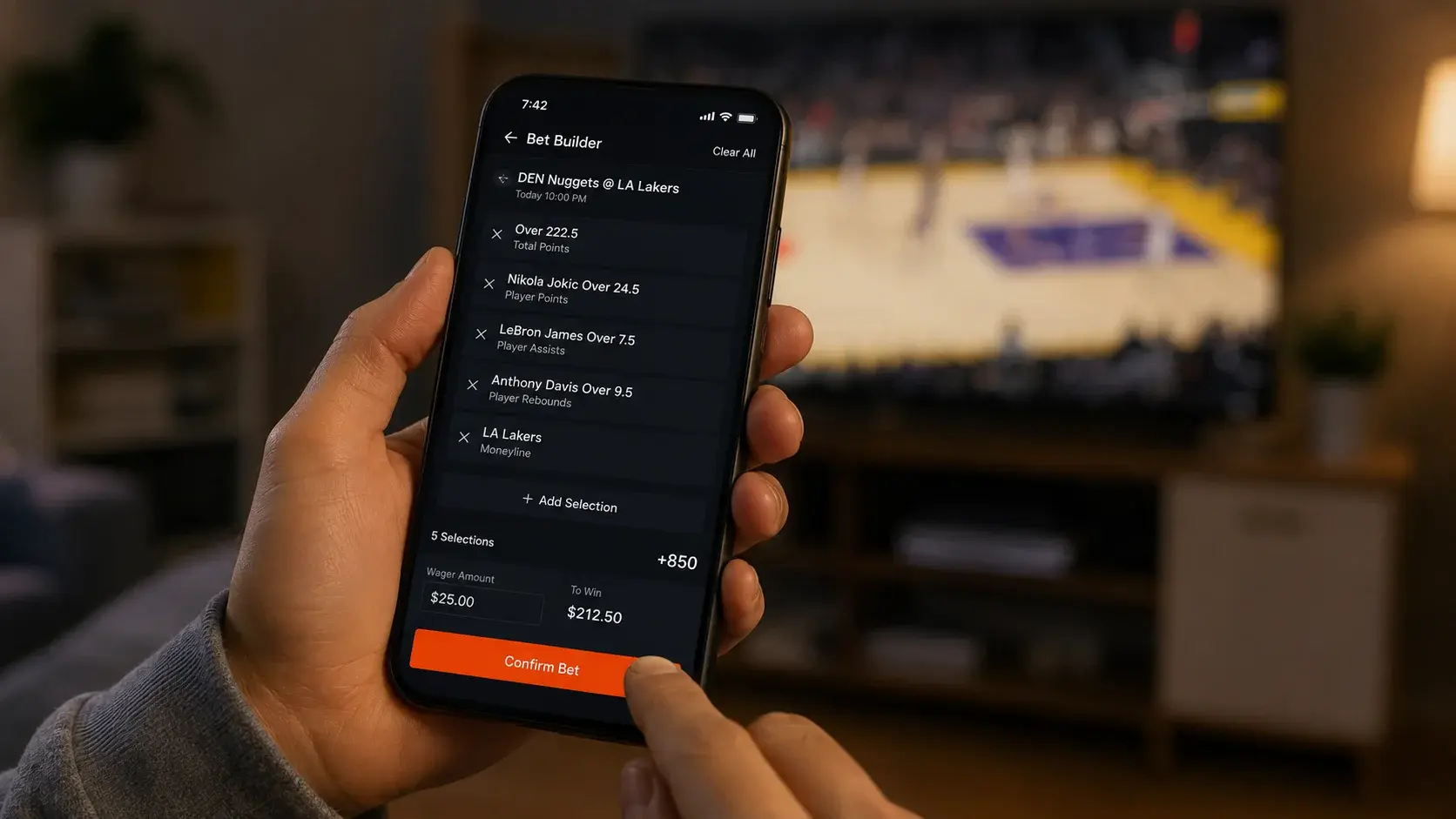
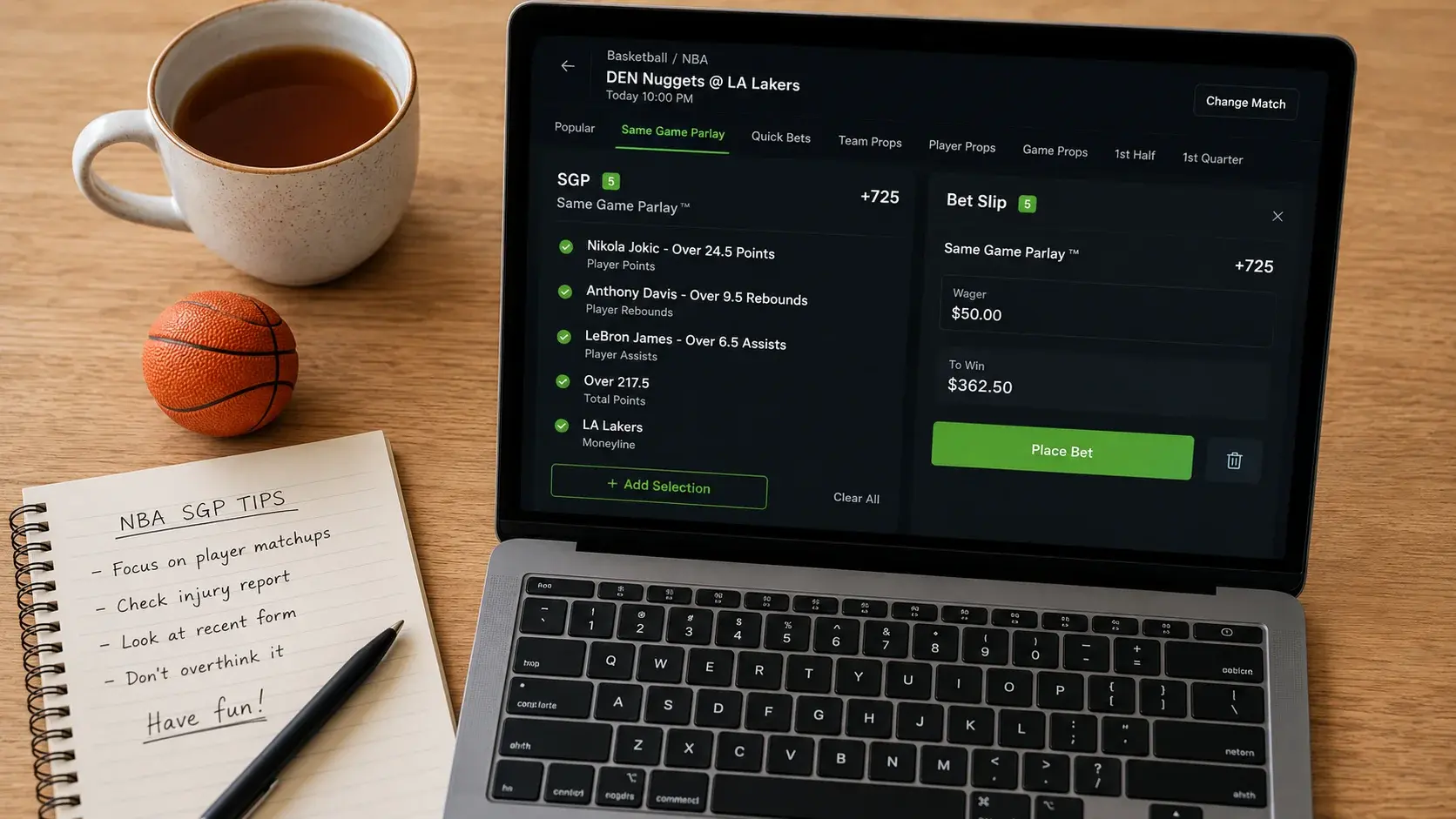
Same-game parlays — also marketed as "bet builders" — allow you to combine selections from a single NBA game into one wager. You might pair a moneyline favourite with a player to score over 25.5 points and the total to go over 218.5. The combined odds look attractive, and that's precisely the point: bookmakers love same-game parlays because the correlation between legs gives them a pricing edge that most recreational bettors don't account for.
I'll be blunt — accumulators are the bookmaker's best friend. The mathematical reality of compounding probabilities means the more legs you add, the more the house edge stacks against you. That doesn't mean you should never play them, but it does mean you should understand the maths before treating a six-leg NBA acca as a strategy rather than entertainment.
NBA Season Structure and What It Means for Betting
Most UK bettors I talk to know the NBA has a regular season and playoffs. Fewer realise how profoundly the structure of the calendar shapes betting markets at every stage.
The NBA regular season runs from mid-October to mid-April, with each of the 30 teams playing 82 games spread across two conferences — Eastern and Western. That volume alone creates opportunities. Unlike the Premier League's 38-match season, the NBA gives you over 1,200 regular-season games to work with. That's 1,200 chances to find soft lines, exploit fatigue, and test your models against real results.
Following the regular season, the Play-In Tournament pits the 7th-through-10th seeds in each conference against one another for the final playoff spots. This four-game mini-tournament generates sharp line movement and volatile markets because the stakes are elimination-level while the sample size for handicapping is tiny. Then comes the main event: four rounds of best-of-seven playoff series, culminating in the NBA Finals in June.
Since 2023, the NBA has also run the NBA Cup — an in-season tournament held in November and December that groups teams into pools and awards a trophy. The Cup games count in the regular-season standings, but the format changes team motivation in ways that affect betting. Some squads treat early Cup games as low priority; others, especially rebuilding teams hungry for a tangible prize, play with visible intensity. Reading that motivation gap is a genuine edge.

The NBA set a record for cumulative attendance over three consecutive seasons from 2023-24 through 2025-26, surpassing 22.18 million fans. That sustained in-arena demand mirrors the league's commercial trajectory — record broadcast deals, record social media engagement, and a betting market that UK operators are scrambling to serve.
From a betting calendar perspective, the key phases are: October-November (early-season volatility, NBA Cup group stages), December-February (stabilising sample sizes, All-Star break), March-April (playoff push, rest and load management), and April-June (playoff intensity, shrinking rotations, tightening defences). Each phase demands a different approach to handicapping, and treating a February back-to-back the same as a May playoff elimination game is a mistake I see constantly. For bettors interested in season-long positions, NBA futures markets — championship odds, MVP wagers, win totals — reward those who understand how value shifts across these phases.
Understanding the season's rhythm is one thing — but choosing where you place those bets matters just as much.
How to Choose an NBA Bookmaker Licensed in the UK
Early in my career I made a spreadsheet of every UK-licensed bookmaker that offered NBA markets. Back then, the list was short. Today, with approximately 29 million active online gamblers in the UK and 78% of sports betting revenue flowing through digital channels, the choice has become almost overwhelming. The good news: that competition benefits you. The bad news: it also means more bad operators hoping you won't check credentials.
The non-negotiable starting point is the UKGC licence. Full stop. If an operator does not hold a valid remote gambling licence from the Gambling Commission, it has no legal right to take your bets, and you have no regulatory protection if something goes wrong. Beyond that baseline, the differences between bookmakers come down to five practical dimensions: market depth, odds competitiveness, in-play quality, withdrawal speed, and responsible gambling tools.
Market depth matters because not all bookmakers treat NBA equally. Some will offer moneyline, spread, and totals on every regular-season game but only list player props for nationally televised matchups. Others give you 80+ markets per game including quarter totals, team props, and alternative handicaps. If you plan to specialise in player props or same-game parlays, verify the depth before you deposit.
Odds competitiveness is harder to assess at a glance, but the principle is simple: over an 82-game season, even a 0.03-point difference in average decimal odds translates into a meaningful sum. Line shopping — comparing prices across multiple bookmakers before placing a bet — is the single easiest way to improve your long-term returns without developing any new analytical skill.
Do
- Verify the UKGC licence number against the Commission's public register before depositing
- Open accounts at three or more licensed bookmakers to enable line shopping
- Test withdrawal speeds with a small cashout before committing larger stakes
- Check that the bookmaker participates in GamStop and offers deposit limits, cool-off periods, and session reminders
- Evaluate NBA market depth during the regular season, not just during the playoffs when coverage is wider
Don't
- Choose a bookmaker solely because of a welcome bonus — promotional terms often restrict how and where you can use free bets
- Use unlicensed offshore operators, regardless of the odds they advertise
- Assume that a large brand name automatically means competitive NBA pricing
- Ignore cash-out terms and partial settlement rules, which vary significantly between platforms
- Overlook the quality of the in-play interface — delayed odds updates during live NBA games cost real money
Before placing your first NBA bet at a new bookmaker
- Confirm the UKGC licence is valid and current
- Set a deposit limit that matches your bankroll plan
- Check that NBA markets are available for the current regular-season schedule, not just marquee games
- Test the in-play interface with a low-stake live bet to assess speed and market availability
- Review the terms and conditions for cash-out, void bets, and overtime settlement rules
- Enable session time reminders and any responsible gambling notifications offered
The operator landscape shifts regularly — new entrants gain licences, existing ones merge or rebrand, and the UKGC periodically updates its requirements. What stays constant is the checklist above. Apply it every time, and you eliminate most of the risk before a single bet is placed.
Betting Integrity: The 2025 Scandal and Its Aftermath
In October 2025, the FBI arrested 34 individuals in connection with two federal investigations into illegal betting and poker schemes linked to the NBA. The cases involved players, intermediaries, and gambling operations that exploited the very markets UK punters wager on daily. NBA Commissioner Adam Silver did not mince words: he described his initial reaction as being "deeply disturbed," adding that he felt "a pit in my stomach" because nothing matters more to the league than competitive integrity.
Adam Silver acknowledged that when sports betting was legalised in the US, the NBA was not part of the negotiations — those deals were struck between states and gaming operators. The league is now working with betting companies on additional controls to prevent manipulation, an approach Silver has described as "learning as we go."
The scandal crystallised a debate that had been building for years around player prop bets. When you can wager on whether a specific player records over or under 5.5 rebounds, the incentive structure for corruption becomes disturbingly direct. A player doesn't need to lose the game — they just need to grab one fewer rebound, miss one more shot, or play one fewer minute than the line suggests. The NBA's official position, laid out in a memorandum to all 30 teams, is that sports leagues should have control over the types of bets offered on their games. Silver has stated unequivocally that protecting competitive integrity "for our fans, our teams and everyone associated with our sport" is the league's top priority.
Timeline of key events
October 2025: 34 arrests in two FBI-led operations targeting illegal NBA-linked betting. December 2025: NBA circulates internal memorandum calling for league control over bet types. Ongoing 2026: Multiple US states review restrictions on player prop markets; UKGC monitors cross-border implications for licensed operators.

For UK bettors, the practical implications are threefold. First, integrity monitoring at UKGC-licensed bookmakers is more robust than in most US state-regulated markets — suspicious betting patterns trigger automated alerts that flow to both the operator's compliance team and the Commission. Second, the range of available prop markets could narrow in coming seasons if the NBA's lobbying efforts succeed. Third — and this is the one most bettors don't want to hear — if you're betting on obscure player props in low-profile regular-season games, you're operating in the segment of the market most vulnerable to manipulation. That doesn't mean every prop bet is compromised. It means you should factor integrity risk into your selection process the same way you factor in injury reports and pace data.
Watching NBA in the UK: Broadcast, Streaming, and Bet Timing
Primary UK Broadcaster
TNT Sports (via Discovery+)
Direct NBA Option
NBA League Pass — multiple tiers available
Typical UK Tip-Off Window
11:00 PM — 3:30 AM GMT (regular season)
There is an irony that sits at the heart of UK NBA betting: the best in-play opportunities arrive precisely when most of Britain is asleep. Regular-season games typically tip off between 11:00 PM and 3:30 AM GMT, which means the bulk of live betting action happens in the small hours. I've learned to structure my week around this — certain midweek slates I'll stay up for, others I'll pre-bet and review in the morning.
The 2025-26 NBA season pulled 170 million viewers across ABC, ESPN, Amazon Prime Video, NBC, Peacock, and NBA TV. Globally, fans consumed more than 1.3 billion hours of live NBA broadcasts — a staggering 93% increase year on year. For UK viewers, the primary gateway is TNT Sports, which carries regular live coverage and is accessible through the Discovery+ streaming platform. NBA League Pass remains the most comprehensive option for watching every game, offering full-game replays, condensed versions, and live access to out-of-market matchups. League Pass has improved its UK-facing product significantly in recent seasons, though blackout restrictions on TNT-aired games still apply.
The relationship between viewing access and betting is tighter than most people appreciate. Live betting — the fastest-growing segment of NBA wagering — depends entirely on your ability to watch the game in real time. A two-minute stream delay means you're reacting to odds that have already shifted, and the bookmaker's algorithm has already adjusted. If you intend to bet NBA in-play seriously, investing in the lowest-latency broadcast available is not optional.
Weekend matinee games, which typically tip off between 8:30 PM and 10:00 PM GMT, are the sweet spot for UK live bettors. These are often the highest-profile matchups of the week, which means deeper markets and tighter spreads. They're also the games most UK viewers actually watch, which in turn means the bookmakers' models face the most public scrutiny on pricing accuracy.
For a comprehensive comparison of every broadcast and streaming option, pricing tiers, and a breakdown of which time slots suit different betting styles, the guide to NBA live betting in the UK covers the viewing-to-wagering pipeline in full.
Responsible Gambling Tools for UK NBA Bettors
I'll share something that doesn't appear in most betting guides: I've used deposit limits on my own accounts. Not because I had a problem, but because automating discipline is easier than relying on willpower at 2:00 AM after a bad beat. The tools exist for everyone, and using them is a sign of competence, not weakness.
The numbers behind problem gambling are stark. Research presented to the House of Lords found that 60% of gambling industry profits come from just 5% of customers — those who are either problem gamblers or at serious risk of becoming one. That concentration should trouble anyone who bets regularly, because it means the industry's financial incentives are structurally misaligned with player welfare. The UK's regulatory response is the most comprehensive in the world, but it only works if you engage with it.
18+ only. All forms of gambling in the UK are restricted to individuals aged 18 and over. If you are under 18, no licensed operator should allow you to open an account or place a wager. If any site lets you bypass age verification, it is operating illegally.
The exposure of young people to gambling marketing is a related concern. Research cited in UK parliamentary proceedings found that 96% of individuals aged 11 to 24 had encountered gambling-related marketing messages within the month preceding the study. That saturation creates normalisation effects that the industry is only beginning to grapple with, and it reinforces why personal safeguards matter — especially for the under-35 demographic that makes up the majority of UK NBA viewers.
Key UKGC-mandated tools available at all licensed bookmakers
GamStop — national self-exclusion for 6 months, 1 year, or 5 years across all licensed online operators. Deposit limits — daily, weekly, or monthly caps you set and which the operator must enforce. Cool-off periods — temporary account suspensions of 24 hours to 6 weeks. Session time reminders — alerts after a set period of continuous play. Reality checks — notifications showing net losses during a session. Account history — full access to your transaction and betting history for self-review.

The best time to set these controls is when you first open an account — before the first NBA tip-off, before the first wager, and before any emotional decisions can override your plan. If you find that your betting is causing anxiety, if you're chasing losses beyond your pre-set limits, or if someone close to you has expressed concern, the responsible step is to use these tools immediately. The National Gambling Helpline and organisations like GamCare offer confidential support, and GamStop activation takes effect within 24 hours across every licensed site.
Strategy Snapshot: Where the Edge Comes From
After eleven years of modelling NBA markets, I can summarise my entire strategic framework in one sentence: the edge comes from information asymmetry applied with discipline. That's it. Every technique I use — ATS analysis, pace modelling, rest-day adjustments, line movement tracking — is a method for knowing something the closing line doesn't fully reflect.
The NBA's 82-game regular season is both a blessing and a curse for bettors. It generates an enormous sample of data, which makes statistical models more reliable than in almost any other sport. But it also means bookmakers have the same data, and their algorithms are fast. The gap between a sharp bettor and the market is narrower in NBA than in, say, college basketball or lower-league football. That narrow gap makes discipline the differentiating factor. A strategy that wins 54% against the spread is profitable over a season. A strategy that wins 54% but is applied recklessly — oversizing stakes, chasing losses, betting on impulse — will still lose money.
Do
- Track your bets rigorously — every selection, stake, odds, and result logged and reviewed weekly
- Focus on one or two bet types until you build genuine competence before diversifying
- Use against-the-spread records over at least 20 games before drawing conclusions about a team
- Factor schedule context into every wager: back-to-backs, travel distance, days of rest, altitude
- Bet with a flat staking plan or percentage-based system — never with emotion-driven unit sizes
Don't
- Bet on every game — selectivity is the single strongest predictor of long-term profitability
- Chase losses with larger stakes after a losing night
- Confuse entertainment bets (parlays, long-shot props) with strategy bets (spread, totals)
- Ignore line movement — if a spread shifts from -3.5 to -5.0, something happened, and you need to know what
- Treat any single game as a "sure thing" — the NBA produces upsets with a regularity that humbles overconfidence
The beginner's roadmap — including bankroll sizing, first bet types, schedule-based edges, and the psychology of managing losing streaks — is laid out in the complete NBA betting strategy guide for beginners. For those already past the fundamentals, the advanced territory is where edges compound: pace-adjusted totals, closing line value analysis, and identifying rest-day market inefficiencies that most recreational bettors overlook.
Strategy gives you direction. The answers below handle the most common questions that arise along the way.
Frequently Asked Questions
Is NBA betting legal in the UK?
Yes. Betting on the NBA is fully legal in the UK provided you use an operator licensed by the UK Gambling Commission under the Gambling Act 2005. Any bookmaker offering services to UK residents must hold a valid remote gambling licence, which you can verify on the UKGC's public register. Unlicensed offshore operators are illegal and offer no regulatory protection.
What are the most popular types of NBA bets?
The five most widely offered NBA bet types at UK bookmakers are moneyline (picking the outright winner), spread or handicap (betting on the margin of victory), over/under or totals (betting on combined points scored), player props (individual statistical performance), and parlays or accumulators (combining multiple selections into one bet). Moneyline and spread bets account for the largest share of NBA betting volume in the UK.
How does NBA spread (handicap) betting work?
Spread betting applies a virtual advantage or disadvantage to a team's final score. If the favourite is listed at -6.5, they must win by 7 or more points for a bet on them to pay out. If the underdog is at +6.5, they can lose by up to 6 points and the bet still wins. UK bookmakers display spreads in decimal odds, typically around 1.91 on each side, with the half-point ensuring there is no push (tied result against the line).
Does overtime count in NBA bets?
It depends on the bet type. Moneyline bets and spread (handicap) bets include overtime — the final score after any extra periods determines the result. Over/under (totals) bets on the full game also include overtime points. However, quarter bets, half-time bets, and most period-specific markets settle on regulation time only and exclude any overtime scoring.
What are NBA player prop bets?
Player prop bets are wagers on an individual player's statistical performance in a game rather than on the team outcome. Common prop markets include points scored, rebounds, assists, three-pointers made, steals, and blocks, each set at an over/under line. Player props are the fastest-growing NBA market but also the most scrutinised for integrity risks following the 2025 betting scandal.
What is the best overall strategy for NBA betting?
The most effective NBA betting strategy combines statistical analysis (ATS records, pace data, net ratings), schedule context (back-to-back games, rest days, travel distance), disciplined bankroll management (flat staking or percentage-based systems), and rigorous bet tracking. Focus on one or two bet types, avoid betting every game, and prioritise closing line value over short-term results. Selectivity and patience consistently outperform volume and intuition.
When is the best time to bet on the NBA?
The optimal timing varies by market and strategy. For spread and totals bets, early-morning lines (UK time) often offer value before the market sharpens throughout the day. Injury news typically breaks 60-90 minutes before tip-off, making that window critical for line movement. Futures bets — such as championship or MVP wagers — offer the most value at the start of the season or immediately after significant roster changes, when bookmaker uncertainty is highest.